In the UK, around 64,000 men are diagnosed with prostate cancer each year, and one in eight men will receive a prostate cancer diagnosis in their lifetime. These alarming statistics highlight the prevalence of prostate cancer and the critical need to deliver targeted treatments, driving research efforts worldwide. Recently, researchers in collaboration with the CLF’s Lasers for Science Facility (LSF) have been exploring incorporating tiny gold nanoparticles into cancer cells to increase the effectiveness of traditional radiotherapy.
Radiotherapy is used in approximately 50% of cancer patients because of its ability to employ X-ray radiation to kill cancer cells by lethally damaging their DNA (the genetic information which codes for living things) inside cells.
A significant drawback of its use is that it damages not only the cancerous tissue, but also the surrounding healthy tissue. This is particularly problematic when treating prostate cancer, as damage to close-by organs can lead to side effects such as bowel problems, incontinence, infertility and erectile dysfunction.
Much more than jewellery: gold’s role in radiotherapy
Due to its excellent biocompatibility, gold is well tolerated by human cells and tissues, underpinning its applications in dental restorations and medical implants. Gold also has a high atomic number, meaning it absorbs X-ray radiation exceptionally well compared to surrounding soft tissue. This absorption of X-rays results in an intense burst of electrons that deposit their energy nearby through a process called the photoelectric effect. As such, gold increases the sensitivity of tissue to radiotherapy and is termed a radiosensitiser.
Cancer cells need to take up more nutrients and material to sustain rapid, uncontrolled cell division, so when tiny flecks of gold are administered into the body, far more are absorbed by cancer cells than healthy cells. This results in an increase in the amount of radiation energy absorbed within the tumour volume, reducing radiation exposure to surrounding healthy tissue. Consequently, cancer patients could be provided with clear benefits of lower dose radiotherapy for shorter periods to reduce side effects on surrounding tissues and organs.
Despite their theoretical brilliance, there are significant delivery challenges associated with gold nanoparticles when used alone. They must be the correct size and prevented from agglomerating (sticking together) to move through the cell membrane. Free gold nanoparticles are around 800 times smaller than the width of a human hair (typically ranging between 1 and 100 nanometres (nm)), so they are rapidly cleared by the body and are too small to carry large quantities of gold into tumour cells.
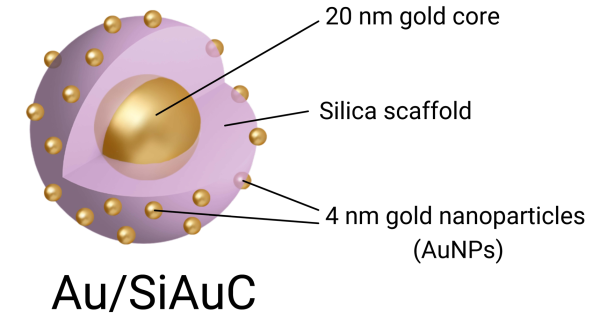
To overcome this therapeutic barrier, scientists have developed a gold structure that can be absorbed by cancer cells effectively. This solution involves incorporating gold nanoparticles into larger engineered structures known as nanocomposites.